
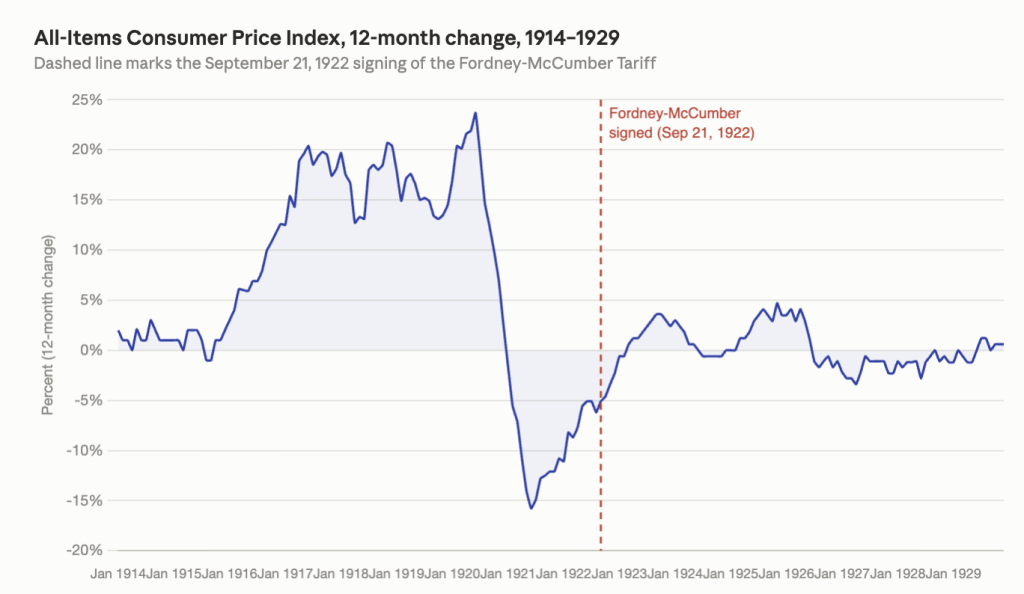
At some point, we’ve got to stop listening to mainstream economists and their anti-tariff narratives. The proof simply doesn’t exist for what they claim tariffs do as you can see from the graph below.
Now don’t take my word for it, this is from the BLS itself:
“After 1922, however, relative price stability reigned for the rest of the decade. Prices rose an average of 1.4 percent annually from 1922 to 1926, then fell an average of 1.1 percent annually from 1926 to 1929.
The 12-month change in the CPI stayed between a rise of 4.1 percent and a decline of 2.8 percent for the entire period, a clear contrast to the double-digit increases and decreases seen from 1916 to 1922.
Food prices showed a little more volatility, with a notable spike in 1925. The relative stability that held from 1922 to 1929 did not, however, mean that policymakers didn’t concern themselves with price changes: vigorous debates about prices and attempts at major regulation characterized the period.”
The agricultural sector did not recover as well as the rest of the economy did from the recession of the early 1920s. Foreshadowing later efforts, concern about inadequately low agricultural prices sparked attempts at regulation in the late 1920s.
President Coolidge repeatedly vetoed the McNary–Haugen bill, which would have established agricultural price supports in an attempt to restore relative prices received by agricultural producers to their 1909–1914 average.“
Nothing in this BLS report suggest that the massive Fordney/McCumber tariff of 1922 had any impact on prices or economic growth.
Obviously, the next question would be to ask, “Well, maybe that tariff wasn’t very large to begin with?”
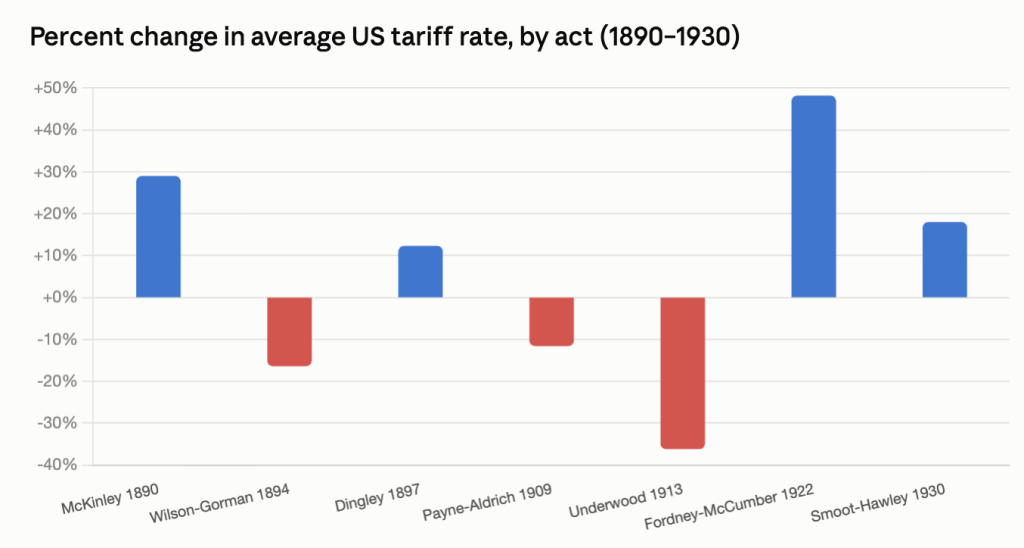
Well, the actual data show the 1922 tariff bill was the largest increase in tariff rates in the US since 1870.
Now, one could make an argument that the reason the 1922 tariffs didn’t cause inflation or even cause an economic decline was because we were coming out of a rather big post War depression. Okay, not a bad argument but then that destroys the idea that tariffs are inflationary.
If the largest tariff hike since the end of the Civil War didn’t cause inflation then logic dictates tariffs don’t inherently cause inflation. Could tariffs cause inflation? Sure. But the proof is quite clear that there is no basis to claim they do cause inflation.
Side note, you’ll see the other large tariff hikes in blue above. The 1890 McKinley tariff certainly didn’t cause massive inflation. In fact, in 1893 the US went into a pretty significant depression which really had nothing to do with the McKinley tariff though.
We did have pretty high inflation after the Dingley Tariff of 1897. I suppose if you really want to stretch you could make a case the tariff caused that. But in reality there was a massive increase in the quantity of gold that hit the market in the late 1890s and early 1900s. So it’s tough to point to Dingley and say that’s proof.
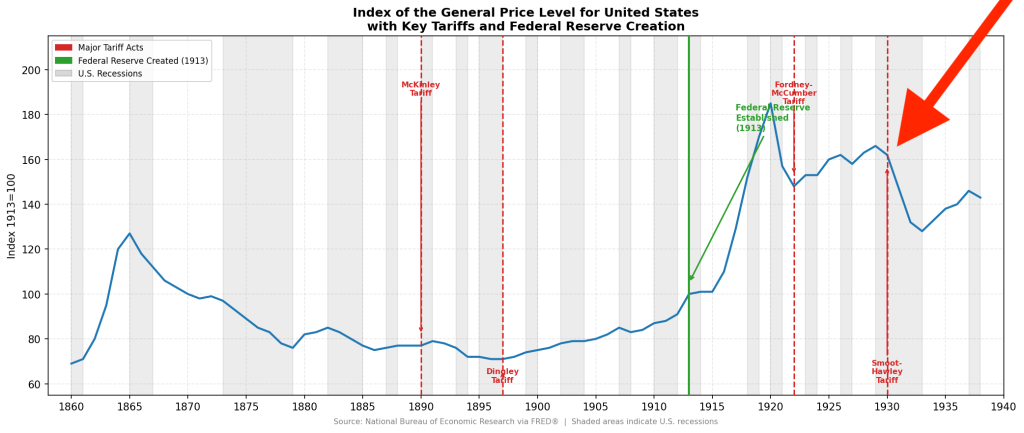
Obviously, no one would say Smoot Hawley was inflationary, after all people will claim that helped lead us into the Great Depression, a depression by its very nature is the opposite of inflationary. As you can see below, when Smoot Hawley was signed into the law the price level was already dropping. Did this tariff have an impact on furthering price declines? A bit. But, again, that’s 180 degrees from being inflationary.
So, maybe it’s time we actually see tariffs for what they are; a tool to be used to encourage American production to allow us to become less reliant countries who hate us.