
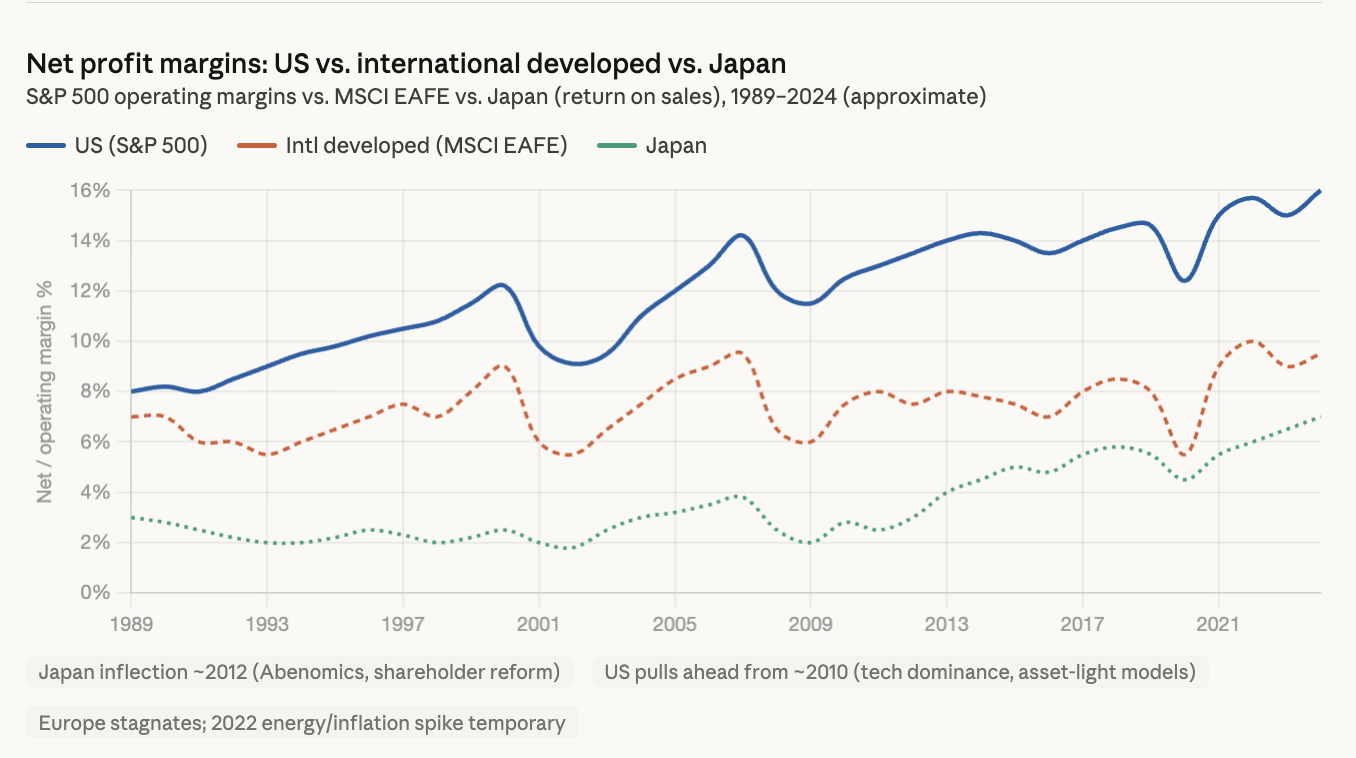
A few big themes jump out across the 50-year span.
The US structural breakout after the GFC. From the end of WWII through roughly 2000, US corporate profits as a share of GDP largely ranged between 5% and 7%, but since the 2008–09 financial crisis they climbed to around 11%. McGraw Hill Higher Education That’s not a cyclical blip — it looks like a permanent regime change driven by structural factors.
The tech and asset-light revolution. At the end of 2024, the S&P 500’s year-end average net margin was 9.75% compared with 5.85% for the period 1989–2015. T. Rowe Price The key driver is sector mix: software and platform businesses can add revenue with near-zero marginal cost, something a manufacturer building a new plant simply can’t replicate. Interest and taxes as a share of earnings before interest and tax fell steadily, and was responsible for more than 40% of real earnings growth from 1989–2019. T. Rowe Price
Europe has stagnated. German, French, UK and Canadian earnings growth are all expected to contract in 2024. Consensus Economics Europe’s margins are structurally lower — burdened by heavier labor regulation, less tech concentration, and energy exposure. A 2022–23 surge in energy and transport sector margins was temporary. Strip those out and, as the Allianz research found, margins in France remained at their lowest level since the mid-1980s through early 2023. Allianz Trade
Japan is the interesting countertrend. From 1960 to around 2012, the average return on sales for Japanese companies was just under 3%, while post-2012 this rose to an average of nearly 5.5%. GMO The shift came from Abenomics-era corporate governance reform, deleveraging after the “lost decades,” and a new focus on shareholder returns. Japan is the one major market where the margin trajectory is actually improving — though it’s still well below US levels.
The gap is real but may not be permanent. Historically, investment on the scale of the current tech capex has failed to deliver anticipated returns T. Rowe Price, which is one of the main reasons analysts question whether today’s US profit premium can hold. Heavy AI capex, rising labor costs, potential tax increases, and a more fragmented trade environment all create headwinds — especially for the hyperscalers whose margins have done the most to lift the US average.