
I was reading about the credit crunch in the late 60s from a Federal Reserve bulletin. I had never heard of this issue before and it stunned me. So with the help of ChatGPT i went down a rabbit hole while looking at Regulation Q, interest rates, and the banking system. ChatGPT did a lot of the legwork here by the way. I want to be upfront. But it was hugely interesting, confusing, yet interesting.
It started with a pretty straightforward observation.
During much of the 1970s and early 1980s, Regulation Q limited the interest rate banks and savings institutions could pay depositors. By 1981, for example, ordinary savings deposits might pay around 5%, while Treasury bills were yielding well into the double digits.
Not surprisingly, people moved money out of banks and savings & loans and into Treasury securities, money-market funds, and other higher-yielding investments.
Economists call this disintermediation.
The traditional explanation goes something like this:
Deposits left the banks, so banks had less money available to lend.
That sounds reasonable.
But there’s a problem.
That’s not really how banks make loans.
Banks Don’t Simply Lend Out Deposits
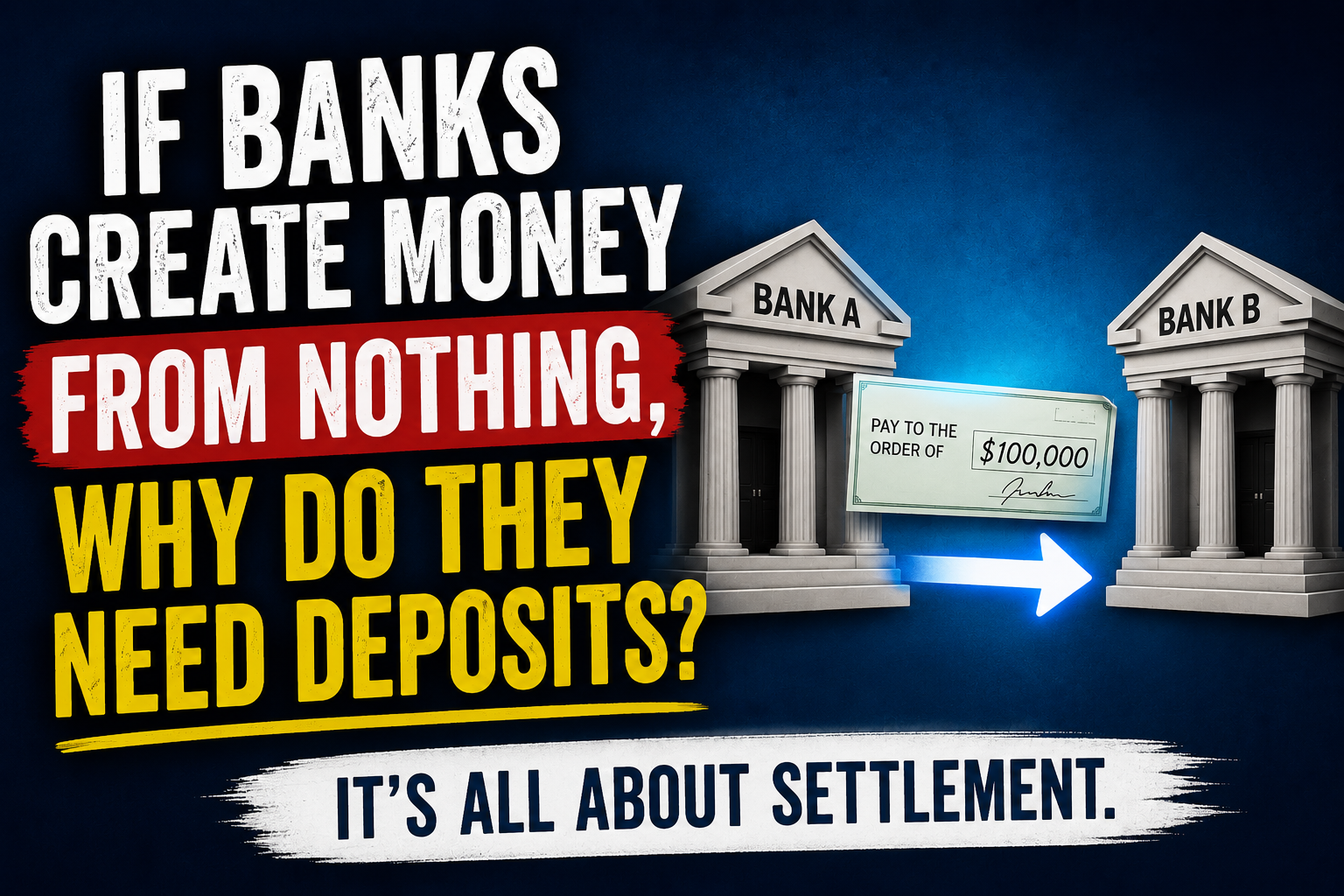
Suppose I walk into Bank A and ask for a $100,000 mortgage.
The bank looks at my income, credit, assets, down payment, etc., and approves the loan.
Bank A doesn’t necessarily go searching through its vault for $100,000 that another customer deposited.
Instead, the bank creates two entries on its balance sheet.
| Bank A | Assets | Liabilities |
|---|---|---|
| Mortgage owed by me | +$100,000 | |
| Deposit in my checking account | +$100,000 |
I now have $100,000 in my checking account.
I also owe Bank A $100,000.
Bank A has a $100,000 asset—the mortgage—and a $100,000 liability—the money in my checking account.
The bank created the deposit by making the loan.
No saver had to deposit that particular $100,000 first.
No pile of $100,000 had to be removed from the vault.
And importantly, Bank A did not need to remove $100,000 from its Federal Reserve account to create my deposit.
That raises an obvious question.
If banks can create deposits when they make loans, why should deposits leaving the banking system prevent banks from lending?
That’s where things get interesting.
I Buy the House
Now I give the seller my $100,000 check.
The seller doesn’t use Bank A.
He uses Bank B.
He deposits my check into his Bank B account.
At first glance, this seems incredibly simple.
I owe Bank A $100,000.
Bank A owns my $100,000 mortgage.
I now own the house.
The seller no longer owns the house.
The seller has a $100,000 deposit at Bank B.
And Bank B owes the seller $100,000.
Everything appears to balance.
And it does.
But there’s one additional relationship we need to account for.
What Exactly Did Bank B Receive?
The seller didn’t walk into Bank B carrying $100,000 of currency.
He carried a $100,000 check drawn on Bank A.
When Bank B accepts that check, it can credit the seller’s account $100,000.
Bank B now has:
| Bank B | Assets | Liabilities |
|---|---|---|
| Claim on Bank A | +$100,000 | |
| Seller’s checking account | +$100,000 |
Again, everything balances.
And this is where I initially found the usual explanation of bank reserves confusing.
Bank B hasn’t somehow lost $100,000.
It has a $100,000 asset.
But what is that asset?
It’s not $100,000 of physical cash.
It’s a $100,000 claim against Bank A.
That distinction turns out to be important.
We Could Actually Stop Right Here
Imagine there were no Federal Reserve and no reserve balances.
Bank B could simply say:
“Bank A owes us $100,000.”
That’s a perfectly legitimate asset.
And tomorrow perhaps Bank B’s customers write $70,000 worth of checks to Bank A customers.
Now:
Bank A owes Bank B: $100,000
Bank B owes Bank A: $70,000
The banks could net the two obligations.
Bank A now owes Bank B only:
$30,000
There’s nothing inherently impossible about such a system.
In fact, various forms of correspondent banking and private clearing arrangements historically operated using exactly this sort of logic.
But eventually Bank B may say:
“We don’t want an IOU from Bank A. We’d like Bank A to actually settle what it owes us.”
Now we’ve reached the purpose of reserves.
Clearing Is Not the Same Thing as Settlement
This distinction cleared up a lot of my confusion.
Clearing determines who owes whom.
Settlement extinguishes those obligations.
Bank B can hold a $100,000 claim against Bank A.
But if Bank B wants that obligation finally settled, Bank A needs to transfer an asset that both institutions recognize as final payment.
In today’s U.S. banking system, that’s generally money held at the Federal Reserve.
Bank A has a reserve account at the Fed.
Bank B has a reserve account at the Fed.
Settlement can therefore result in:
Bank A Fed balance: −$100,000
Bank B Fed balance: +$100,000
Bank B no longer has a claim against Bank A.
It instead has an additional $100,000 claim against the Federal Reserve.
That’s final settlement.
But Here’s the Important Part
Bank A didn’t need those reserves to create my mortgage.
That’s where the traditional description of banking can lead people astray.
The sequence isn’t necessarily:
Depositor saves $100,000 → bank receives $100,000 → bank lends me that $100,000.
Instead, it can be:
Bank makes loan → bank creates deposit → borrower spends deposit → payment goes to another bank → banks clear and settle obligations.
Those are very different descriptions of banking.
So Why Can’t Bank A Just Create Another $100,000?
This was my next question.
Bank A created my $100,000 deposit.
Why can’t Bank A simply “snap its fingers” and create the $100,000 Bank B needs?
Because Bank A can create its own liabilities.
It can’t unilaterally create an asset that another bank must accept as final settlement.
Bank A can certainly tell Bank B:
“We owe you $100,000.”
And Bank B can carry that $100,000 receivable.
But that’s an IOU from Bank A.
If Bank B wants final settlement, it wants something other than another Bank A IOU.
That’s one reason central-bank money sits at the center of the banking system.
But Doesn’t Regulation Prevent Banks From Going Crazy Anyway?
Yes.
And this is another important distinction.
It’s sometimes argued that banks need reserves because otherwise Bank A could simply create $10 billion of loans, create $10 billion of deposits, have its customers spend the money at other banks, and force those banks to accept Bank A’s newly created money.
But that’s mixing together two separate issues.
Banks already face numerous constraints on reckless lending.
They have capital requirements.
They have liquidity requirements.
They have credit standards.
They face regulatory supervision.
They have to manage credit losses.
They have leverage constraints.
And, perhaps most importantly, they need to make profitable loans to borrowers likely to repay them.
So reserves aren’t simply there to prevent banks from recklessly creating loans.
Their role in interbank settlement is a separate issue.
Which Brings Us Back to Regulation Q
And this is where the original question gets much more interesting.
The conventional story says:
Regulation Q capped deposit rates.
Market interest rates rose above those ceilings.
Savers withdrew deposits.
Banks lost deposits.
Banks therefore had less money to lend.
Credit contracted.
Housing suffered.
There’s clearly truth in the overall story.
But saying banks simply “ran out of deposits to lend” is misleading.
Banks create deposits when they make loans.
The more interesting problem is what happens after those deposits leave the originating institution.
Suppose Bank A creates a mortgage.
The borrower spends the deposit.
That money ends up at Bank B.
Bank A now has to manage the resulting funding and settlement consequences.
When deposits are plentiful and inexpensive, this may not be particularly difficult.
But imagine it’s 1981.
A regulated savings account might pay roughly:
5.25%
while Treasury bills yield approximately:
14%.
Why would a saver leave large amounts of money earning 5.25% when safe short-term government securities were paying dramatically more?
Money leaves traditional deposit institutions.
Those institutions now have to replace that funding.
And replacement funding might cost 10%, 12%, 15% or more.
That’s a completely different problem from saying:
“The bank doesn’t have any money left to lend.”
The bank can still create a loan.
The question becomes:
Can the bank profitably fund the asset it just created?
And This Was Particularly Nasty for Savings & Loans
This distinction becomes especially important when looking at the old S&L industry.
Many thrifts held enormous portfolios of long-term, fixed-rate mortgages.
Imagine an institution holding mortgages paying:
7%
Its traditional deposit funding might have cost:
4–5%.
That’s a workable spread.
But now market interest rates explode.
Treasury bills pay double digits.
Depositors start leaving.
Eventually the institution has to obtain much more expensive funding or pay much higher rates to retain deposits.
Suddenly you might have:
Mortgage assets yielding 7%
funded by liabilities costing:
10%, 12% or even more.
That’s a disastrous business model.
The institution hasn’t lost the magical ability to create a loan.
Its funding economics have collapsed.
And that’s a much better way to understand what disintermediation was doing.
The Money Didn’t Disappear
This is another crucial point.
When someone withdrew $100,000 from an S&L and bought Treasury bills, $100,000 of wealth didn’t disappear from the economy.
It moved.
The saver exchanged one financial asset for another.
That’s why the term disintermediation is so useful.
The saver was moving away from a traditional financial intermediary.
But the composition of credit could change dramatically.
The S&L might have used its funding structure to hold residential mortgages.
A money-market fund buying Treasury bills wasn’t necessarily going to turn around and finance someone’s 30-year home mortgage.
So the quantity of financial assets wasn’t necessarily shrinking.
The channels through which credit flowed were changing.
This Changes How I Think About Regulation Q
I started with the standard explanation:
Deposits leave → banks have less money → banks make fewer loans.
I don’t think that’s a sufficiently precise way to describe what happened.
A better framework is:
Banks create deposits when they make loans.
↓
Borrowers spend those deposits.
↓
Payments frequently move to other banks.
↓
Banks acquire claims against one another.
↓
Those claims ultimately have to be funded and settled.
↓
Banks therefore care enormously about the cost and stability of their liabilities.
↓
Regulation Q prevented institutions from competitively pricing an important source of those liabilities.
↓
When market rates soared above Regulation Q ceilings, deposits fled.
↓
Institutions had to shrink, find alternative funding, or pay dramatically more for funding.
↓
Credit—particularly mortgage credit—became more expensive and/or less available.
That’s much subtler than saying banks “lend out deposits.”
And it raises an even bigger question.
If banks can create deposits when they lend, obtain reserves after the fact, borrow from other institutions, and ultimately obtain liquidity from the central bank, exactly which constraint made Regulation Q-era disintermediation so damaging to credit creation?
Was it really reserve scarcity?
Was it funding costs?
Was it regulation?
Was it the unique structure of savings & loans?
Was it the mismatch between long-term fixed-rate assets and short-term liabilities?
Or was it some combination of all of them?
That’s where I think this gets really interesting.
Because understanding that distinction may also explain why raising interest rates today doesn’t necessarily affect the financial system in exactly the same way that raising rates did during the Regulation Q era.